

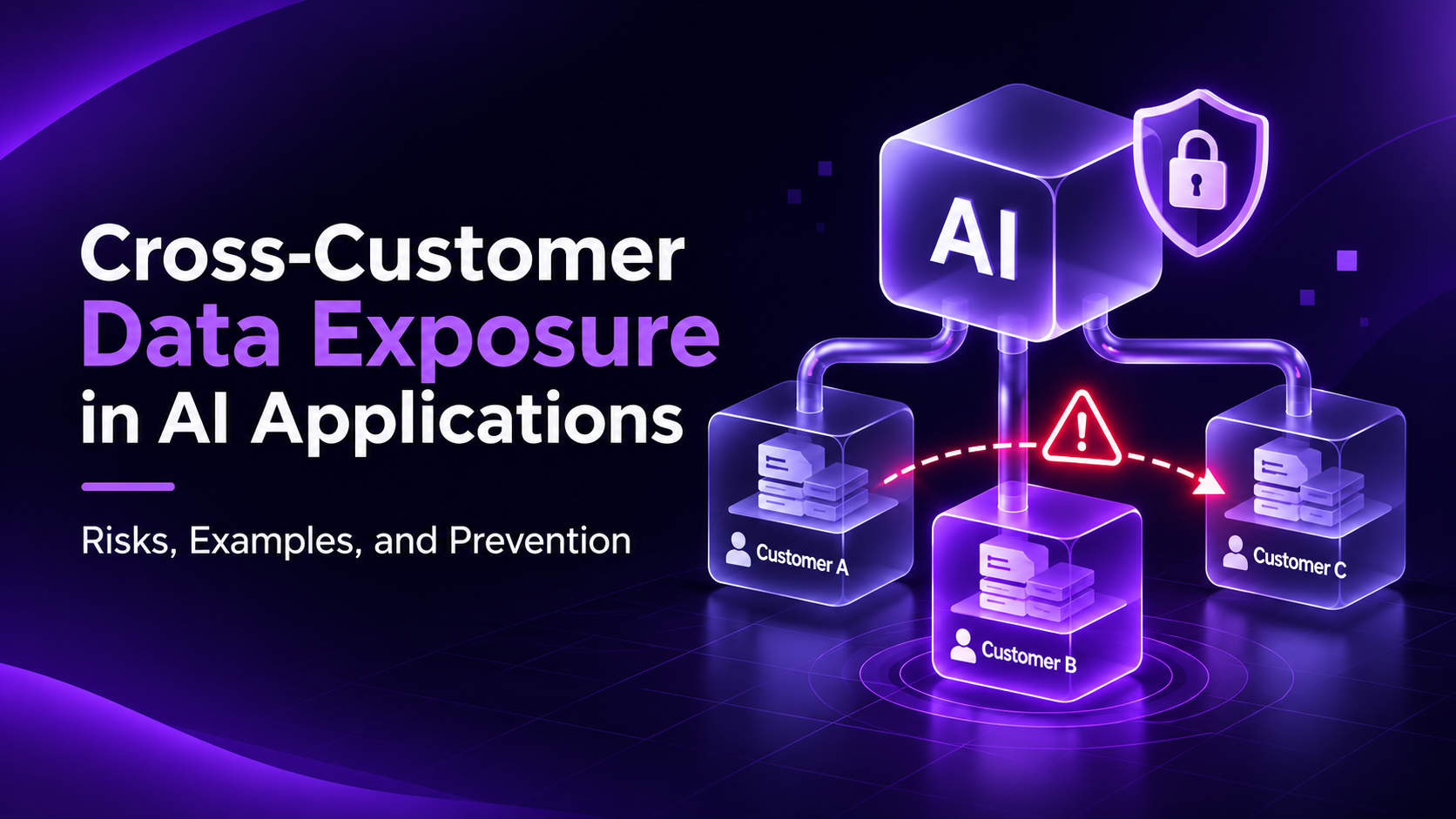
Imagine a customer asking an AI-powered support assistant about a subscription renewal. Instead of providing information limited to their account, the assistant shares another company's negotiated pricing, contract details, and support ticket.
The response may be accurate, but it exposes confidential information to an unauthorized customer. This is cross-customer data exposure in AI applications, a security risk in which an AI system unintentionally retrieves or discloses information belonging to another customer, organization, or tenant.
As enterprises adopt Retrieval-Augmented Generation (RAG), shared vector databases, AI agents, and third-party integrations, maintaining strict customer data separation becomes increasingly important.
A misconfigured retrieval pipeline, improperly scoped cache, or overprivileged AI agent can create pathways to sensitive customer information.
The challenge is no longer limited to protecting AI models. Organizations must understand how identities, permissions, data sources, and connected systems interact throughout their AI infrastructure.
What Is Cross-Customer Data Exposure in AI?
Cross-customer data exposure occurs when an AI application provides one customer or user with access to another customer's confidential information without authorization.
This risk is particularly relevant to multi-tenant SaaS platforms, where multiple organizations share application infrastructure, databases, AI services, or connected resources.
For example, an enterprise AI assistant may retrieve information from a shared vector database. If tenant-level restrictions are missing or incorrectly applied, a query from one organization could return documents belonging to another.
Sensitive information can appear in:
- AI-generated responses and conversation histories.
- RAG retrieval results and vector databases.
- Shared caches and stored sessions.
- AI agent tool calls and enterprise integrations.
- Source citations, document metadata, and attachments.
Even exposing a customer name, document title, or contract reference can reveal commercially sensitive information.
A Real-World Example: The March 2023 ChatGPT Incident
In March 2023, OpenAI reported a data exposure incident involving a bug in an open-source library used by ChatGPT.
The issue allowed some users to see chat titles belonging to other active users. OpenAI also reported that payment-related information may have been visible for approximately 1.2% of ChatGPT Plus subscribers active during a specific nine-hour window.
Potentially exposed information included names, email and billing addresses, card types, the last four digits of payment cards, and expiration dates.
The incident demonstrated how a vulnerability in supporting infrastructure, such as a caching library, can expose user information even when the AI model itself is functioning correctly.
Where Does Cross-Tenant Data Leakage Occur in AI Systems?
1. RAG Pipelines and Vector Databases
RAG systems retrieve information from external documents, knowledge bases, and enterprise databases before generating responses. If tenant-level and document-level permissions are not enforced during retrieval, information from another customer's knowledge base may enter the model's context.
For example, a SaaS support assistant retrieves a private renewal agreement belonging to Customer B while answering a billing question from Customer A.
Grafyn’s Discovery & Visibility helps identify vector databases, knowledge sources, AI assistants, and their connections across enterprise environments. Sensitive Data Disclosure helps assess exposure of sensitive customer information across AI-related content and workflows. Agentic Identity Blast Radius Analysis helps teams understand which identities AI agents act as, what sensitive data those identities can reach, and which trust boundaries they cross. This connects retrieval-related identity exposure with sensitive data access. Additionally, RAG Pipeline Poisoning helps assess risks involving manipulated documents and retrieved content that could influence AI-generated responses.
2. Shared Caches and Conversation Memory
AI applications use caching to improve response speed and reduce repeated processing. However, improperly scoped caches can reuse personalized responses or conversation data across users with different permissions.
For instance, two shoppers ask about recent orders. A shared response cache incorrectly returns Customer A's delivery address to Customer B.
Grafyn’s Sensitive Data Disclosure helps identify sensitive customer information handled across AI applications, prompts, files, agents, and workflows. This visibility helps security teams identify applications processing customer PII and prioritize the review of associated caches, session stores, and tenant-isolation controls. Grafyn does not directly inspect or enforce application-level cache scoping.
3. AI Agents and Third-Party Connectors
AI agents interact with APIs, CRM platforms, databases, and enterprise applications. If an agent operates through an overprivileged service account, it may access information beyond the requesting user's authorization.
For example, an insurance support agent retrieves another policyholder's claim documents because its shared CRM connector has broader access than the employee requesting the information.
Grafyn’s Agentic Identity Blast Radius Analysis helps security teams understand which identities an agent acts as, what sensitive data it can reach, and which trust boundaries it crosses.
4. Background Jobs and Data Indexing
Background processes import, process, and index enterprise documents. Incorrect tenant identifiers or permission metadata can make documents accessible through the wrong customer's AI search environment.
For example, a document-processing workflow assigns an enterprise contract to the wrong tenant during indexing, allowing an AI assistant to retrieve it for an unauthorized customer.
Grafyn’s Discovery & Visibility helps organizations identify AI assets, owners, connections, and associated risks across their AI environment.
5. Logs and Observability Systems
AI logs may contain prompts, uploaded files, retrieved documents, and tool responses. Excessive access to these records can create another pathway for sensitive information exposure.
For example, a support employee accesses a centralized logging platform containing confidential contract excerpts from multiple enterprise customers.
Cross-Customer Data Exposure Risks Across Industries
Different industries face different AI data exposure challenges depending on the information they process and the systems connected to their applications.
How to Prevent Cross-Customer Data Exposure in AI Applications
Organizations need a structured approach to protect customer information across AI applications, retrieval systems, and connected enterprise resources.
1. Establish Tenant Identity and Access Controls
Every AI request should be associated with a verified user identity and tenant context. Organizations should derive tenant information from authenticated sessions and enforce permissions consistently across APIs, databases, and connected services.
Example: When a customer switches between enterprise workspaces, the application must verify the active workspace before retrieving documents or processing subsequent requests.
Grafyn’s Agentic Identity Blast Radius Analysis helps security teams understand agent identities, inherited permissions, accessible sensitive data, and trust boundaries. Application-level tenant authorization must still be enforced by the underlying systems.
2. Enforce Access Controls During Data Retrieval
RAG pipelines and vector databases must apply tenant- and document-level restrictions before providing information to AI models. The same restrictions should apply to citations, attachments, and downloadable documents.
For example, if an employee loses access to a customer contract, the AI assistant should no longer retrieve that document or provide access through previously generated citations.
Garfyn’s Sensitive Data Disclosure helps organizations assess sensitive information exposure across AI-related content and workflows. Agentic Identity Blast Radius Analysis helps security teams understand which identities AI agents act as, what sensitive customer data those identities can reach, and which trust boundaries they cross. Together, these capabilities help identify potential exposure arising from excessive permissions or identity-based access to customer information. Actual tenant-level and document-level retrieval authorization must still be enforced by the application and data layer.
3. Secure Shared Caches and Conversation Histories
Cached responses and stored conversations should be associated with the correct customer identity and permission context. Personalized information should never be reused across customers simply because their questions are similar.
For example, two banking customers asking identical loan eligibility questions must receive responses based on their respective financial records.
Grafyn’s Sensitive Data Disclosure helps security teams understand where sensitive information appears across AI prompts, files, agents, and workflows.
4. Apply Least-Privilege Access to AI Agents
AI agents should receive only the permissions required for their assigned tasks. Organizations should review service accounts, API credentials, inherited privileges, and third-party integrations to identify unnecessary access.
For example, an order-tracking agent should not automatically have access to every customer's payment history or confidential account information.
Grafyn’s Agentic Identity Blast Radius Analysis helps assess agent identities, inherited permissions, accessible sensitive data, and trust boundaries.
5. Test Tenant Isolation and Validate Security Controls
Organizations should regularly test whether tenant-level access restrictions remain effective across retrieval systems, caches, AI agent interactions, citations, and background processing. Security testing should identify vulnerabilities that could allow unauthorized access to another customer's data.
Example: Create two test customer accounts containing similar documents but different identifying markers. Simulate attempts to access one customer's information through another account and verify that the AI system blocks unauthorized retrieval and disclosure. Also test whether hidden instructions embedded in a retrieved document could manipulate an AI agent into requesting records belonging to another tenant.
Grafyn’s Agentic Red Teaming runs realistic attack simulations against AI agents to test whether they can be manipulated into accessing unauthorized resources. For example, simulated attacks can use hidden instructions in retrieved documents to attempt to make an agent retrieve another tenant's sensitive information through its connected tools and inherited identities. Grafyn helps security teams understand how far such an attack could propagate across the agent's identity chain, connected systems, and accessible data, while validating whether existing tenant-isolation and access controls can contain the attack and limit its potential blast radius.
6. Assess Trust Boundaries and Potential Blast Radius
Organizations should understand how AI identities, inherited permissions, and connected systems create pathways to sensitive resources. This helps security teams assess the potential impact of an exposed or compromised AI agent.
For example, an AI agent connected to a customer database and multiple enterprise applications has excessive access. Security teams need to understand which additional systems and customer records may be reachable through its identity relationships.
Grafyn’s Trust Boundary Blast Radius Detection helps security teams understand trust relationships and potential blast radius across connected AI environments.